Mana Seekers-What is Science Rotation Lab
Mana Seekers starts with an introduction rotation lab in which students do six different science activities in order to learn Science Standard 1, having the skills necessary in order to create experiments to understand the natural world. Science doesn't have just one way of doing science, there are many. Some ways science is done is to build models, solve problems, and make logical comparisons. We will look at the scientific method as the main way science is done. In order to learns the steps we have different activities.
Activity 1-I can make observations over an extended period of time.
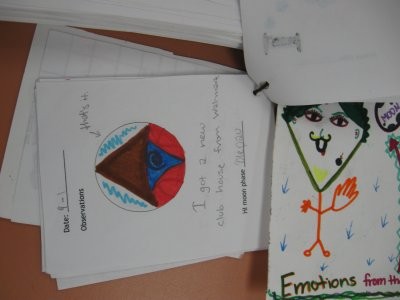
We are making a moon journal to record our scientific observations on one side of the journal page, and our emotional observations on the blank side of the page. I will grade your scientific observations, and you will grade your reflections that you wrote on the blank side of the journal page. We will use this rubric. Click here to see it so you know what you need to observe. We will follow the moon for 28 days, to see how it changes. In this lab activity, we write three observations of the current phase of the moon, using the prompt "I see."
Then we use our eyes as a camera and look at the phase of the moon and then draw it on our journal page. Look at the moon, look at and draw on our journal page. What we see needs to be carefully drawn by looking at the moon, and then our page. That's how careful observations are done.
If we miss a night or cannot see what it looks like there is a resource page where you can see each phase, the Hawaiian name, and the reason certain activities are done during that phase.
Below is an exceptional journal that a student created. It had drawings and reflections on every page for every night of the moon.
Activity 2-Sing the Scientific Method!
There is a song called 'The Scientific Method' that we use to learn the different parts of the steps for doing science.
Here is a copy of the lyrics that we sing.
Activity 3- Switcheroo
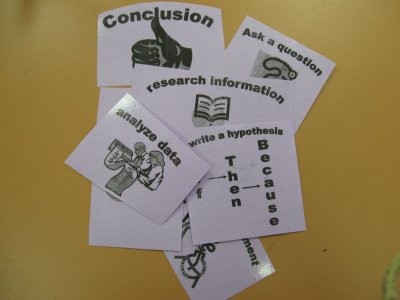
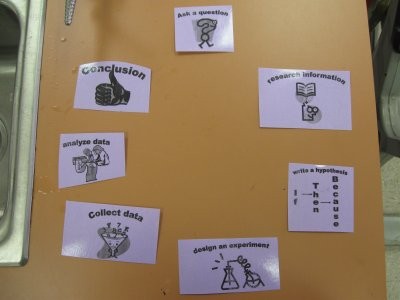
The song mentions seven different steps that scientists use to solve problems. Mrs. Prevenas has made a game that has students putting the steps of the problem in a logical order and then asking what step goes before or after. It's a great way to understand the steps, and it's fun because you get to stand up and move around. We are learning hand signals that go along with each of the steps too. Just another way to learn :)
Activity 4-Vocabulary Search Using the Electronic Thesaurus
In order to really learn the different steps of the scientific method, you also have to know the language. Science words are like a foreign language! To make it more fun, Mrs. Prevenas has added words that have two meanings, one scientific and the other, well different. We used a blank word document and typed in our vocabulary words. Then we highlighted the words and asked the Thesaurus for a similar word. It helps to know of words that mean the same thing, only they aren't so odd or confusing. Mrs. P has put short definitions of all the words here, jsut in case you get stumped, and need a little help. There are 22 Vocabulary words for this unit.
Science-Study
Helio-the Sun
Energy-the ability to make something happen
Transformed-change into something else
Question-a problem to ask, to inquire
Research-study, explore
Hypothesis-a guess based on what you know
Experiment-a test, a trial
Data-information, numbers
Analyze- compare, scrutinize using data
Conclusion- finish, closing stages
Measure- amount
Revise-change, correct, improve
Electromagnetic Spectrum- band, variety, range of energy
Dependent- reliant, need
Independent- free, on your own
Variable-change, flexible
Qualitative- a feature or trait you observe
Quantitative- can be measured and represented with numbers
Metric-measuring units
Reflection-likeness, sign, signal, consider, thought
Activity 5- Word Search
There is a wonderful website that helps you make all kinds of cool word puzzles. It's called puzzlemaker. Every unit we learn vocabulary and use the word search puzzles to help us become more familiar with the new words. Check it out for yourself! I put the 22 words in a word search and got the activity that is assigned at this station.
http://puzzlemaker.discoveryeducation.com/
Activity 6- Reading the textbook to find important information
Lastly, for the readers and visual learners, we have our textbook, Sciencesaurus. Our text has a wonderful introduction to how science is done and more information about the special skills that scienctists use to do science. I created an activity guide to help you through the reading by recognizing and pointing out important vocabulary words. You need to be able to learn from a variety of sources, in a variety of ways, including the good old fashioned book!
